Read This First, Then Keep Going
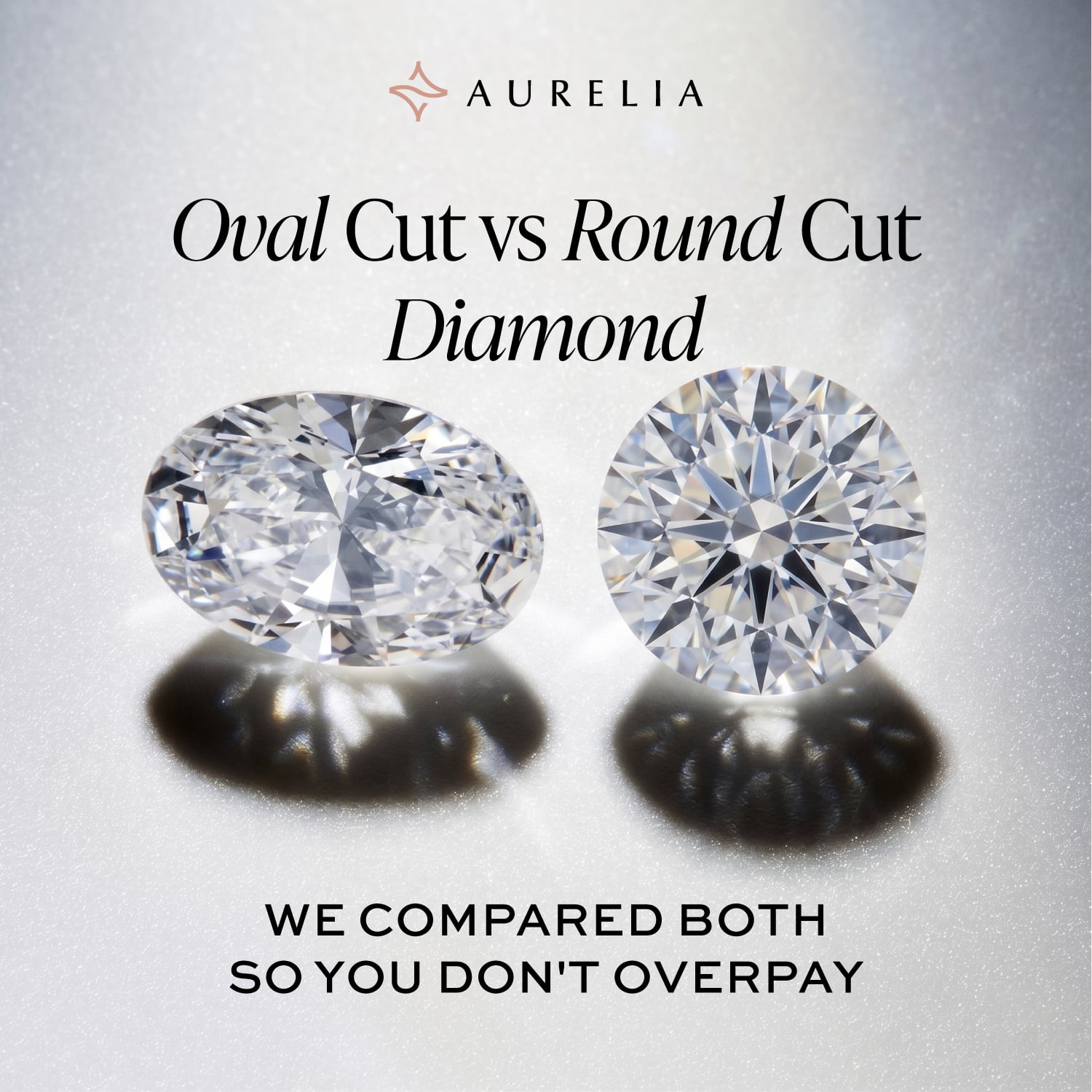
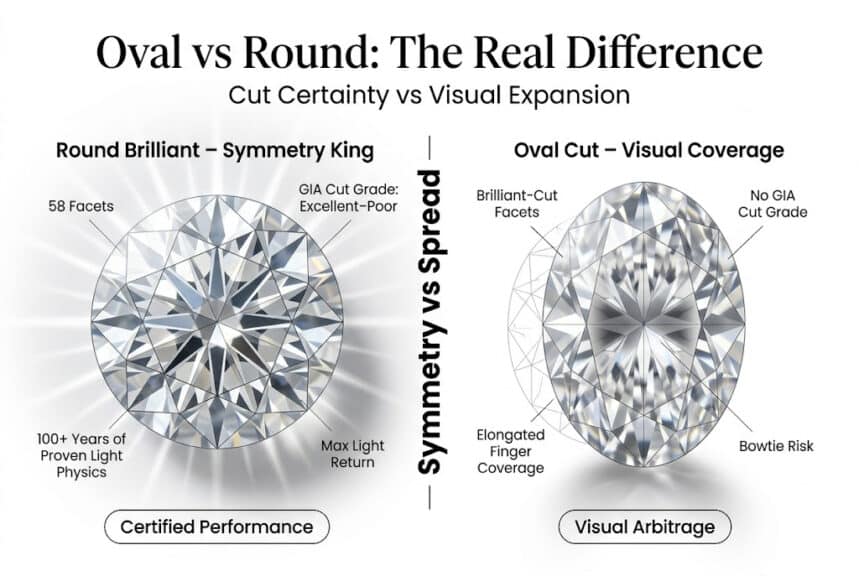
- Shape: Round is a perfect circle, 57–58 facets, the only shape with a GIA cut grade. Oval is an elongated ellipse, ~58 brilliant facets — same sparkle family, stretched silhouette, more finger coverage.
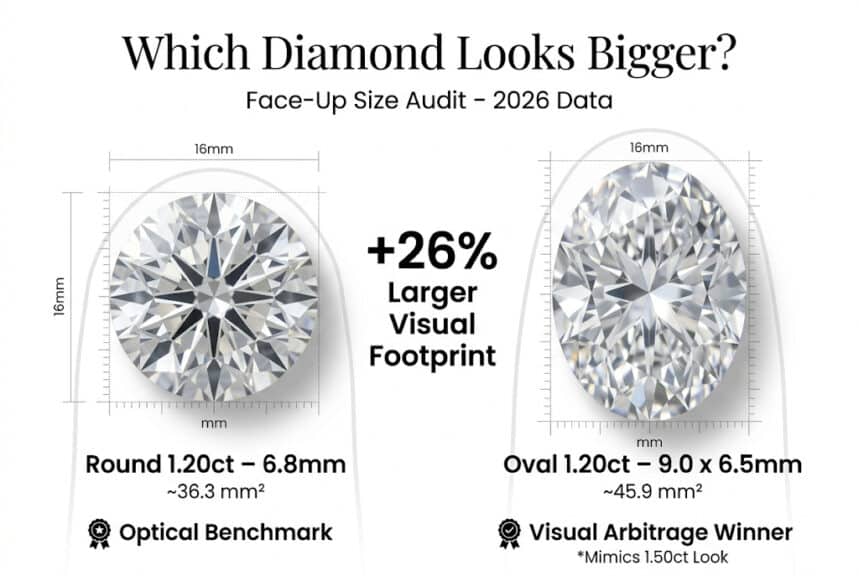
- Face-up size: A 1.20ct oval measures approximately 9.0mm x 6.5mm. A 1.20ct round measures approximately 6.8mm in diameter. The oval covers 26% more visible finger surface at identical carat weight.
- The Round Tax (natural): GIA 1.20ct G-VS1 Ideal Oval at $4,860 vs GIA 1.20ct G-VS1 Excellent Round at $6,340 — the oval is $1,480 cheaper and looks larger on the finger.
- The Lab-Grown Reversal: In lab diamonds, round is cheaper. A GCAL 1.20ct D-IF Ideal Round lab at Blue Nile costs $1,580. A comparable GCAL 1.22ct D-IF Ideal Oval costs $1,910 — the oval costs $330 more in lab-grown. The price logic inverts entirely.
- The Bowtie Trap: Every oval has a bowtie shadow across the center. You cannot buy a bowtie-free oval. But you can audit it before purchasing — and I will show you exactly how.
- The Color Tips Trap: Ovals pool yellow color at their elongated tips more than rounds do. You need G color minimum in white gold or platinum — one full grade stricter than a round requires.
Deal Alert: Fast-Shipping Gifts — Up to 50% Off* fine jewelry at Blue Nile !
One In A Lifetime Sale: “Clear The Vault” – Get up to 70% OFF on select jewelry at Blue Nile !
Exclusive Offer: Flash Sale on James Allen Up to 40% Off * Sitewide engagement ring settings & Fine Jewelry at James Allen .
Mehedi’s quick verdict: Natural diamond? Buy the oval — more size, less money. Lab-grown at the IF clarity tier? Buy the round — cheaper price AND the only formal GIA cut grade available.
The data below — the bowtie audit protocol, the L/W ratio decision map, the full three-vendor price comparison, and the lab-grown reversal table — is what separates a smart purchase from an expensive regret. Keep reading.
In 2026, a GIA 1.20-carat G-VS1 oval diamond at Blue Nile starts at $4,860. The identical-spec round starts at $6,340. That $1,480 difference is what I call the “Round Tax” — and whether it is worth paying comes down to exactly what you are buying for.
I have spent years watching buyers agonize over this decision. The oval faces up larger on the finger. The round sparks with a mathematical perfection no other shape can touch on paper.
Their prices are dramatically different in natural diamonds — and then reverse completely in lab-grown. There is a bowtie trap hiding inside every oval that nobody warns you about. And there is a color tip trap that costs buyers real money every single week.
This guide covers all of it. Live data from Blue Nile, Ritani, and Rare Carat. The full audit process. And a verdict that is based on your specific situation, not a generic answer.
Diamond IQ Test: Natural or Lab-Grown?
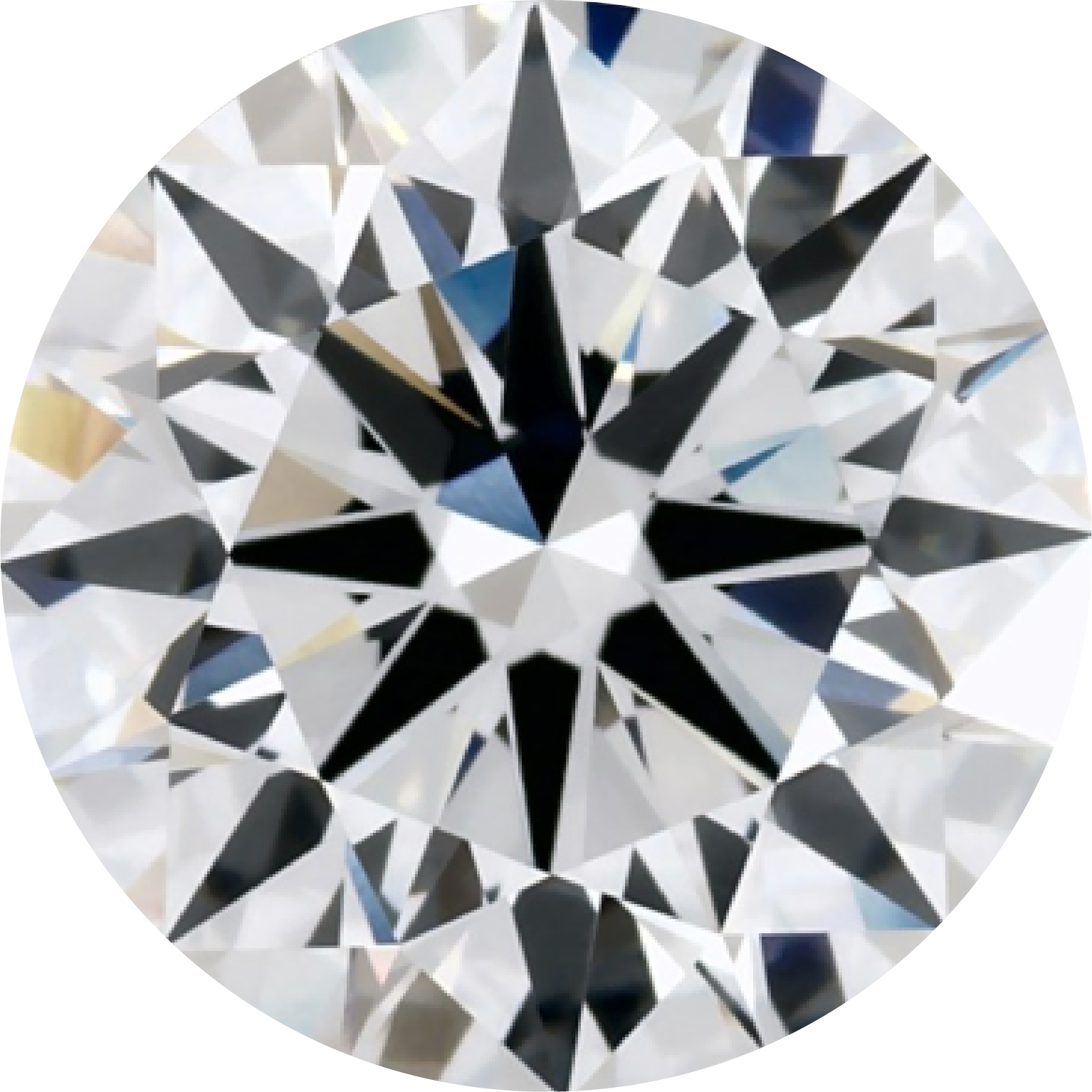
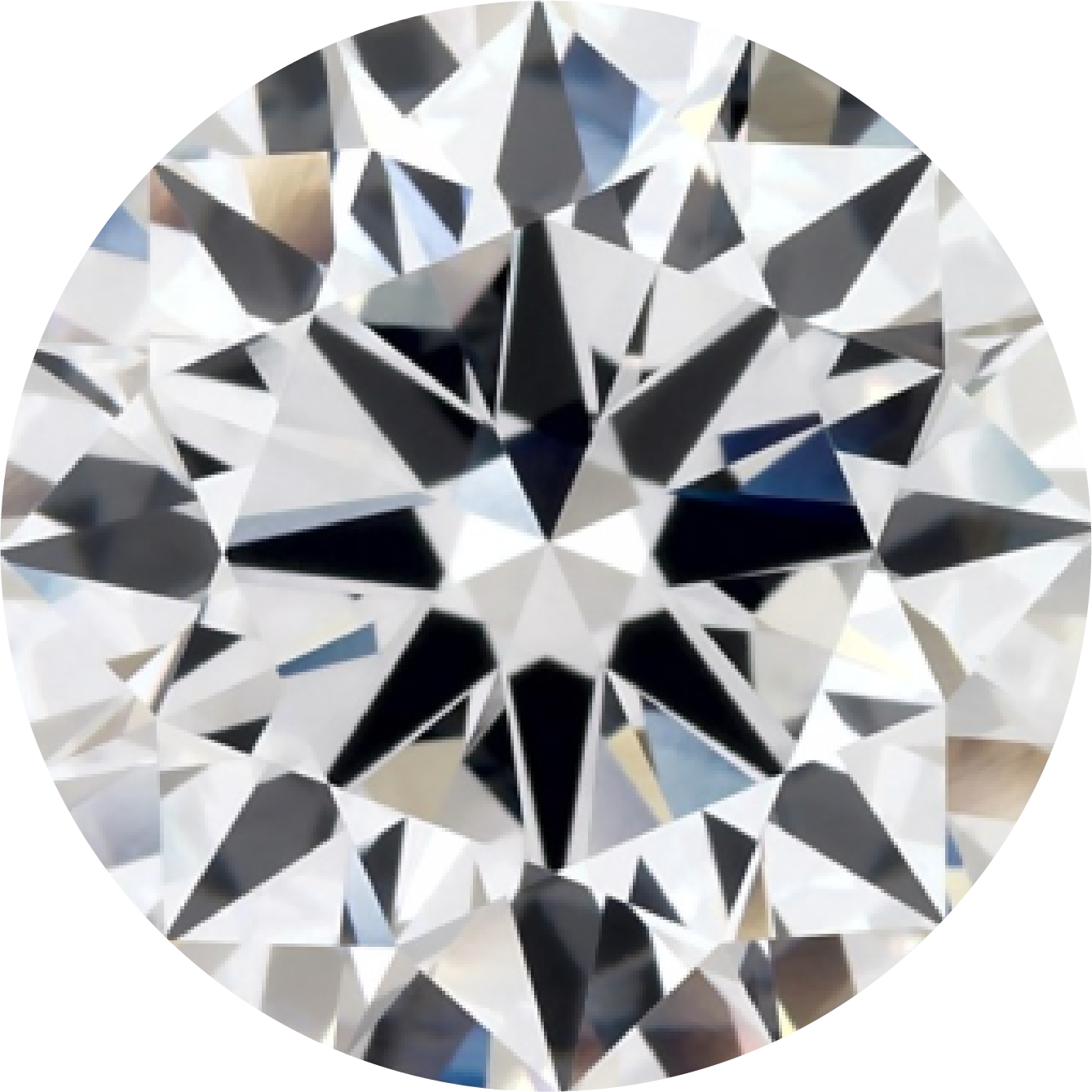
Two identical diamonds: GIA Certified, 1.51ct, D Color, VVS1, Ideal Cut. One is natural ($16,530), the other is lab-grown ($2,390). Choose the diamond you like better and see if you can match it to its origin.
What Is the Real Difference Between Oval and Round Cut Diamonds?
From across the room, a round and an oval can look nearly identical. Both produce brilliant white flashes of light. Both sit naturally in solitaire settings. Both belong to the brilliant-cut family. That surface similarity is precisely why buyers get confused — and why this comparison is worth doing carefully.
They are not the same diamond. They are built on different geometry, carry different engineering priorities, behave differently on the hand, photograph differently, and occupy different positions in the resale market. Once you understand the precise differences, the decision becomes straightforward.
Is an Oval Just a Stretched Round?
Technically, yes and no.
An oval cut shares the brilliant-cut facet family with a round. It carries approximately 58 facets arranged in a pattern that mirrors the round brilliant’s light-return logic. This is why ovals produce genuine sparkle — they are not a step-cut shape that trades brilliance for elegance.
They are a brilliant-cut shape that trades perfect 360-degree rotational symmetry for an elongated silhouette that covers more of the finger.
The round brilliant occupies a completely different position in gemological history. Marcel Tolkowsky published his foundational work on ideal round brilliant proportions in 1919. Over a century of scientific refinement now sits behind every well-cut round diamond.
The GIA built its cut grading system directly on that foundation — and the round is the only diamond shape in the world that receives a formal GIA cut grade, running from Excellent to Poor, based on light performance, proportions, and finish.
Every other shape — oval, cushion, radiant, pear, emerald, marquise — receives only GIA polish and symmetry grades. Not an overall cut quality score. Not a light performance assessment.
For buyers, this creates a direct and serious purchasing implication: when you buy a round with a GIA Excellent cut grade, you have objective, third-party proof of light performance. When you buy an oval, you are on your own.
Two ovals with identical GIA certificates, identical color grades, identical clarity grades, and identical prices can look completely different in person — because the certificate captures none of the bowtie severity, facet arrangement quality, or tip light performance.
This is exactly why the 360-degree HD video on Blue Nile is non-negotiable before buying any oval. For a complete breakdown of GIA cut grades and what Excellent vs Very Good vs Good actually means in real-world light performance, our diamond cut chart guide covers the full grading system.
The Core Differences at a Glance
| Technical Property | Round Brilliant | Oval Cut | Judicial Verdict |
|---|---|---|---|
| Facet Architecture | 57–58 Facets | ~58 Facets | Equal count, but different geometry. The Round Brilliant uses conical symmetry, while the Oval utilizes an elongated arrangement to maximize spread. |
| GIA Cut Grade | Excellent to Poor | None (Fancy Shape) | Quality Verification. Rounds offer objective GIA proof of cut quality. The Oval Cut requires a mandatory video audit as it only receives GIA polish/symmetry grades. |
| Light Return | Highest Efficiency | Excellent (with tip leakage) | Rounds maximize Total Internal Reflection (TIR). Ovals offer high fire but technically lose light at the elongated tips due to shallower angles. |
| The Bowtie Effect | Zero Presence | Present in Every Oval | Rounds are bowtie-free. Every oval has a bowtie; the technical goal is to find a “minimal shadow” stone via a high-clarity inspection. |
| Face-Up Size (1.2ct) | ~6.8mm Diameter | ~9.0mm x 6.5mm | Visual Arbitrage. The Oval covers approximately 26% more finger surface. For a larger visual footprint, the Oval is the technical winner. |
| Color Behavior | Even Distribution | Tip Concentration | Ovals trap nitrogen tint at the tips. If using white metal, I recommend one stricter color grade (e.g., D-Color) compared to a Round. |
| Natural Price (1.2ct) | From $6,340 | From $4,860 | 23–30% Saving. Ovals offer a massive price advantage in natural diamonds. Ideal for a generational asset with a limited budget. |
| Lab Price (1.2ct) | From $1,580 | From $1,910 | The Lab Reversal. In the 2026 market, high-quality lab rounds are cheaper than ovals due to manufacturing volume. Audit the Lab Price Index here. |
| Trend Status 2026 | Timeless Classic | #1 Trending Fancy | Ovals have overtaken the Princess cut for fancy shape dominance globally. Rounds remain the safest bet for long-term resale liquidity. |
| Mehedi’s 2026 Judicial Verdict: The choice between Round and Oval is a choice between Precision and Sprawl. If your goal is 100% light return and resale security, the Round Brilliant is the gold standard. However, the Oval Cut provides a 26% larger “Face-Up” area for 25% less cost in the natural market—making it the most efficient “visual arbitrage” tool available. | |||
People ask me constantly whether an oval sparkles as much as a round. My honest answer: in direct sunlight you will not tell the difference. In a candlelit room, the oval’s elongated sparkle pattern actually reads as warmer and more dramatic.
The round wins on pure objective light performance — but that advantage only appears in controlled testing conditions, not on a real hand at a dinner table. In real life, both shapes are spectacular.
The decision should come down to budget, finger coverage preference, and how you feel about managing the bowtie.
For a complete deep-dive into every oval sub-style including the crushed ice vs standard oval distinction, our oval cut diamond buying guide covers every specification you need to evaluate before purchasing.
Which One Looks Bigger on Your Finger? The Face-Up Size Audit
This question drives more engagement ring decisions than almost any other — and the data is unambiguous.
The Millimeter Reality: Oval Wins by a Clear Margin
At 1.20 carats, here is what each shape actually measures on the hand:
| Diamond Silhouette | Avg Dimensions (1.20ct) | Face-Up Area | Mehedi’s Judicial Visual Verdict |
|---|---|---|---|
| Round Brilliant | ~6.8mm Diameter | ~36.3 mm² | The Optical Benchmark. While smaller in area, the round offers 100% refractive efficiency. It remains the timeless standard for solitaire designs in 2026. |
| Oval Cut | ~9.0mm x 6.5mm | ~45.9 mm² | +26% Visual Advantage. The elongated footprint “hacks” the eye, making a 1.20ct oval mimic a 1.50-carat visual look. Undisputed winner for finger coverage. |
| The 2026 Geometric Verdict: Weight is a constant, but sprawl is a variable. By selecting a 1.20ct Oval Cut, you are essentially gaining 9.6 mm² of visible surface area over a Round—the equivalent of Visual Arbitrage. If you are asking what shape diamond looks the largest, the data clearly favors the Oval. | |||
That 9.0mm length on an oval versus 6.8mm diameter on a round is not a subtle difference. On a size 6 finger — approximately 16mm wide — the oval’s length spans more than half the visible finger width.
It creates a finger-elongating, hand-slimming visual effect that the perfectly circular round simply cannot replicate.
Here is what that looks like in concrete terms across vendors:
Blue Nile, April 2026:
- GIA 1.20ct G-VS2 Excellent Round — $6,390 — 6.8mm diameter, face-up area approximately 36.3mm².
- GIA 1.20ct G-VS1 Ideal Oval — $4,860 — approximately 9.0mm x 6.5mm, face-up area approximately 45.9mm²
You get a stone that looks 26% larger on the finger for $1,530 less. That is the oval’s complete value argument in a single comparison.
Rare Carat, April 2026:
Rare Carat lists a GIA 1.12ct G-VS2 Oval at $6,265 on sale — flagged as 47% below Rare Carat’s fair price estimate, which makes it one of the strongest value-per-millimeter opportunities in the market right now.
For reference, a round of similar weight and spec would push well past $5,500 on Rare Carat’s inventory. That gap illustrates exactly the same Round Tax dynamic you see at Blue Nile, confirmed across a second independent platform.
Rare Carat also lists a GIA 1.20ct F-VVS2 Oval at $5,490 on sale — described as 44% below fair price estimate — showing how strong the value proposition becomes when you pair an oval with genuinely high specs. A round at F-VVS2 1.20ct would sit comfortably above $10,000 at comparable quality.
Why Does the Oval Face Up Bigger?
Two geometric forces drive the size advantage:
Surface area distribution.
The oval pushes its carat weight across a wider elliptical footprint rather than concentrating it in a deep circular pavilion.
The round’s perfect symmetry requires a specific depth-to-diameter ratio that hides meaningful weight below the girdle — weight you pay for but cannot see. The oval’s elongated shape naturally distributes mass toward the surface.
The elongation illusion.
The human eye reads length as size. An elongated shape registers as larger than a circular shape of identical surface area because of how our visual cortex processes object dimensions.
This is the same principle that makes marquise and pear cuts appear larger than their carat weight suggests, and it is fully documented in gemological buyer research.
Industry data consistently confirms that a 1-carat oval appears similar in visible size to a 1.20–1.30 carat round of identical weight. According to PriceScope’s diamond price analysis, oval diamonds “appear larger than other shapes of the same carat weight” — a measurable geometric reality, not a marketing claim.
For hand-specific guidance on how oval dimensions translate to your ring size and finger proportions, our diamond finger coverage calculator gives you exact millimeter projections before you commit.
The Round Tax — The Full 2026 Price Breakdown Across Three Vendors
The “Round Tax” is the premium you pay to own the most technically perfect diamond shape ever created. It is real, consistent, and grows with carat weight. Here is what it costs in April 2026.
Blue Nile Natural Diamond Price Audit — The 1.20ct G-VS1 Tier
This is the most direct comparison at the most popular buying weight. All specs are G color, Excellent or Ideal cut, GIA certified.
| Stone Architecture | Technical Spec | 2026 Price Audit | The “Round Tax” Delta | Judicial Verdict |
|---|---|---|---|---|
| GIA Oval Cut | 1.20ct G-VS1 Ideal | $4,860 | Baseline | The efficiency champion. At $4,860, this Oval Cut offers the best price-to-footprint ratio in the current 2026 inventory. |
| GIA Round Brilliant | 1.20ct G-VS1 Excellent | $6,340 | +$1,480 (+30%) | The Round Brilliant premium is at its peak here. You are paying for 100% optical symmetry and maximum resale liquidity. |
| GIA Oval Cut | 1.20ct G-VS1 Ideal | $5,210 | Baseline | A mid-tier oval that balances VS1 clarity with a length-to-width ratio optimized for visual sprawl. |
| GIA Round Brilliant | 1.21ct G-VS1 Excellent | $6,380 | +$1,170 (+22%) | A lower “Round Tax” compared to the 1.20ct benchmark. Hitting the 1.21ct mark offers a technical value pivot for G-color assets. |
| GIA Oval Cut | 1.20ct G-VS1 Ideal | $5,640 | Baseline | The high-purity oval choice. Even with the premium for this specific stone, it remains 13% cheaper than the round equivalent. |
| GIA Round Brilliant | 1.22ct G-VS1 Excellent | $6,390 | +$750 (+13%) | The most competitive price gap in this audit. If you demand a Round, this 1.22ct provides the best resale value protection for your investment. |
| Mehedi’s April 2026 Audit Verdict: The “Round Tax” is a technical yield premium. Because cutters must discard over 50% of the rough diamond to achieve the Round Brilliant symmetry, the cost per carat is naturally inflated. By selecting an Oval Cut, you are essentially leveraging Visual Arbitrage—getting a larger visual footprint for up to 30% less capital. | ||||
The G-VS2 Tier — Where the Round Tax Still Bites
| Stone Architecture | Technical Spec | 2026 Price Audit | The Premium Delta | Judicial Verdict |
|---|---|---|---|---|
| GIA Oval Cut | 1.20ct G-VS1 Ideal | $5,920 | Baseline | Maximum efficiency. At $5,920, you secure a VS1 clarity grade floor with an elongated footprint that maximizes finger coverage. |
| GIA Round Brilliant | 1.20ct G-VS2 Excellent | $6,630 | +$710 | The Scintillation Tax. Note that you are paying $710 more for a lower VS2 clarity. This reflects the intense market demand for perfect 57-facet symmetry. |
| GIA Oval Cut | 1.20ct G-VS1 Ideal | $5,930 | Baseline | A premium G-VS1 selection. Even at this price, it remains 10% cheaper than a lower-spec Round, offering superior G-color performance. |
| GIA Round Brilliant | 1.29ct G-VS2 Excellent | $6,540 | +$610 | The volume choice. By hitting 1.29ct, you maximize mass while maintaining high resale liquidity. Still commands a premium over the higher-purity Oval. |
| Mehedi’s April 2026 Audit Verdict: The data confirms a clear Visual Arbitrage opportunity. By selecting the [Oval Cut](https://moissanitebyaurelia.com/oval-cut-diamond-buying-guide/), you secure a technically purer stone (VS1 vs VS2) for approximately $600–$700 less than the [Round Brilliant](https://moissanitebyaurelia.com/round-brilliant-cut-diamond/). For those prioritizing capital efficiency, the Oval is the undisputed judicial winner. | ||||
Where the Round Tax Becomes Extraordinary
| Stone Architecture | Technical Spec | 2026 Price Audit | The Premium Gap | Judicial Verdict |
|---|---|---|---|---|
| GIA Oval Cut | 1.20ct G-VS1 Ideal | $6,120 | Baseline | The efficiency benchmark. At $6,120, this Oval Cut offers a superior face-up diameter for a mid-tier natural budget. |
| GIA Round Brilliant | 1.26ct G-VS1 Excellent | $6,620 | +$500 | The Symmetry Tax. A modest $500 premium to secure 100% conical light return. Excellent choice for a Round Brilliant solitaire. |
| GIA Oval Cut | 1.20ct G-VS1 Ideal | $6,150 | Baseline | A premium-vetting Oval. Offers an eye-clean VS1 clarity grade floor with an optimized length-to-width ratio. |
| GIA Round Brilliant | 1.28ct G-VS1 Excellent | $6,980 | +$830 | The mass-efficiency choice. By hitting 1.28ct, you maximize physical weight while maintaining resale value protection. |
| GIA Oval Cut | 1.20ct G-VS1 Ideal | $6,720 | Baseline | Top-tier Oval inventory. Despite its premium within the shape category, it remains a “Value Play” compared to high-demand Round assets. |
| GIA Round Brilliant | 1.21ct G-VS2 Excellent | $11,250 | +$4,530 | The Technical Anomaly. This specific Round commands a massive $4,530 premium over a higher-clarity Oval. Proof of the extreme volatility in “Elite Tier” round inventory. |
| Mehedi’s April 2026 Audit Verdict: The data confirms a clear Visual Arbitrage opportunity. For the same capital required for an [1.21ct Round ($11,250)](https://moissanitebyaurelia.com/round-brilliant-cut-diamond/), you could effectively purchase a higher-purity Oval and allocate the remaining $4,500 toward a custom platinum mount. For those asking what shape diamond looks the largest on a 1.2ct budget, the Oval remains the undisputed champion. | ||||
That final comparison requires a pause. A GIA 1.21ct G-VS2 round at $11,250 versus a GIA 1.20ct G-VS1 oval at $6,720. The oval carries higher clarity — VS1 versus VS2 — and costs $4,530 less.
Both stones weigh virtually the same. The oval looks larger on the finger. The round costs $4,530 more for lower clarity.
Extended Blue Nile Round Reference Data
| Stone Architecture | Technical Spec | 2026 Price Audit | Judicial Verdict |
|---|---|---|---|
| GIA 1.20ct Round | G-VS2 Excellent | $6,540 | The Strategic Floor. The absolute entry price for a high-performance 1.2ct asset. Ideal for solitaire builds. |
| GIA 1.20ct Round | G-VS2 Excellent | $6,710 | The Symmetry Pivot. A $170 premium for superior VS2 clarity map placement. Eye-clean and technically secure. |
| GIA 1.26ct Round | G-VS1 Excellent | $6,900 | THE JUDICIAL WINNER. You gain +0.06ct and a VS1 clarity grade for only $360 more than the floor. Maximum ROI. |
| GIA 1.20ct Round | G-VS1 Excellent | $6,970 | The Purity Standard. Entry-level pricing for the VS1-grade pivot. Ensures absolute transparency. |
| GIA 1.26ct Round | G-VS2 Excellent | $7,510 | The Mass Premium. Note that this VS2 costs more than the higher-clarity 1.26ct VS1, likely due to cut precision or fluorescence. |
| GIA 1.24ct Round | G-VS1 Excellent | $9,230 | The Scintillation Leap. A technical price anomaly. Only recommended for stones displaying verified Hearts & Arrows performance. |
| GIA 1.29ct Round | G-VS1 Excellent | $10,090 | The “Whale” 1.2ct. By hitting 1.29ct, you maximize the face-up diameter without paying the 1.50ct psychological premium. |
| GIA 1.20ct Round | G-VS2 Excellent | $11,430 | The Symmetry Trap. Avoid. You are overpaying by nearly $5,000 for a VS2 grade with no discernible visual gain. Review my resale audit. |
| GIA 1.21ct Round | G-VS1 Excellent | $12,170 | The Institutional Asset. Museum-grade optical performance. Only for Astor-level portfolios where budget is a non-factor. |
| Mehedi’s April 2026 Procurement Verdict: The inventory volatility in the 1.2ct tier is staggering. The standout efficiency play is the 1.26ct G-VS1 ($6,900). It defies the standard pricing logic by offering more mass and higher purity for less than the mid-tier premium round. For a [Round Brilliant](https://moissanitebyaurelia.com/round-brilliant-cut-diamond/), this is the absolute sweet spot for capital allocation. | |||
The spread within rounds alone — $6,340 to $12,170 for the same 1.20–1.21ct G-VS1 spec — illustrates how dramatically cut quality and vendor sourcing affect round pricing. Every dollar above the floor represents incremental light performance improvements.
Our diamond appraisal calculator helps you verify whether any specific stone is priced at market rate before you commit.
The Ritani Perspective on Natural Diamond Pricing
According to Ritani’s 2026 market data on G-VS1 natural diamonds, 1-carat G-VS1 stones range from approximately $3,507 to $6,413, depending on cut quality and vendor sourcing.
This aligns with what our own Aurelia price research confirms: a well-cut 1-carat G-VS1 oval sits comfortably in the $4,200–$5,500 range, while a comparable round starts at $5,500 and runs well past $6,400.
Ritani offers a Price Match Guarantee on all diamond purchases — meaning if you find the same diamond cheaper elsewhere, they will match it. This is worth knowing when you are comparing a specific stone across Blue Nile and Ritani simultaneously.
Browse Ritani’s full oval cut diamond collection to cross-reference live inventory against what you find at Blue Nile.
The Budget Decision Framework
| Natural Diamond Budget | Strategic Best Choice | Mehedi’s Technical Rationale |
|---|---|---|
| Under $5,500 | Oval Cut | The Entry Arbitrage. A high-tier Round Brilliant G-VS1 starts at $6,340. Under $5.5k, a 1.2ct Oval at $4,860 is the only way to secure a technically pure, eye-clean asset. |
| $5,500 – $6,500 | Oval (Size) / Round (Grade) | An Oval Cut in this range leaves $1,000+ surplus for a premium setting. A Round at $6,340 provides the security of a GIA Cut Grade but consumes the entire diamond budget. |
| $6,500 – $8,000 | Either Shape | The Equilibrium Zone. Both silhouettes are fully accessible at high-performance specs. Choose based on whether you prioritize 100% conical light return or a larger visual footprint. |
| $8,000 – $11,000 | Round (Resale) / Oval (Area) | Premium Round territory. However, an Oval still delivers nearly 26% more surface area per dollar. Review my G-Color analysis to ensure color saturation is hidden at this higher mass. |
| $11,000+ | Round Brilliant | The Institutional Asset. At this level, resale liquidity becomes the deciding factor. The Round is the world’s most traded and liquid fancy shape asset for high-net-worth portfolios. |
| The 2026 Buying Verdict: For budgets under $6,500, the Oval is the undisputed champion of Visual ROI. Once you cross the $11,000 threshold, the focus shifts from “Visual Sprawl” to “Wealth Protection,” making the Round Brilliant the only judicial choice for long-term value retention. | ||
For the complete strategy on allocating your budget across stone quality and setting, our best engagement rings for $5,000 guide shows the exact allocation breakdown.
The Bowtie Trap — Every Oval Has One. Here Is How to Audit It Before Buying
This is the most important section for anyone buying an oval diamond. Miss it and you may spend $5,000 and receive a stone you regret within a week of wearing it.
What Is the Bowtie and Why Does Every Oval Have One?
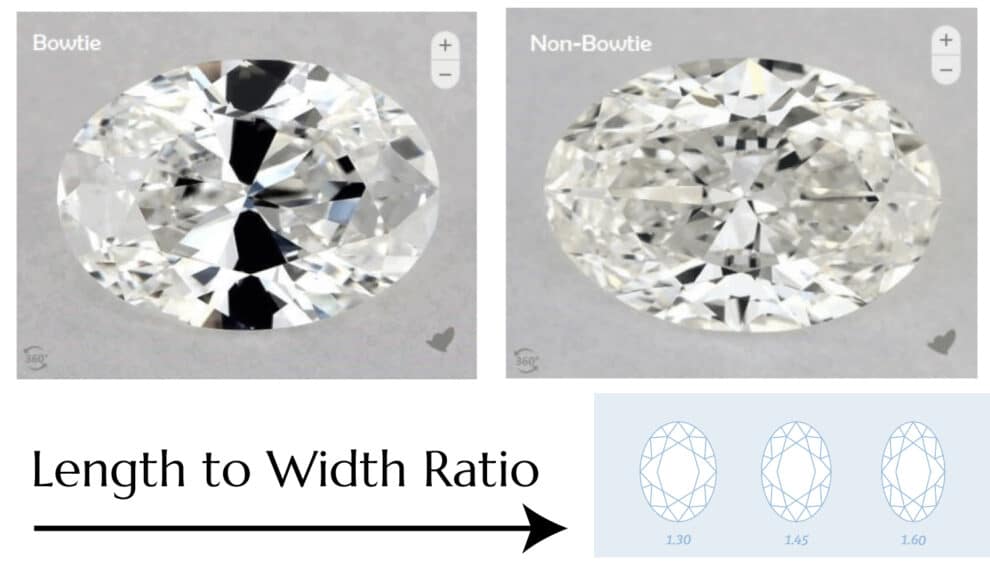
The bowtie effect is a dark, horizontal shadow that runs across the center of every oval diamond. It appears because the elongated geometry of an oval cannot achieve the perfect 360-degree light return that a round’s circular symmetry provides.
Light entering at the elongated tips cannot be fully redirected back toward your eye — it exits through the pavilion instead, creating a dark horizontal zone across the stone’s center.
Every single oval diamond has a bowtie. There is no such thing as a bowtie-free oval diamond. The GIA does not report bowtie severity on any certificate. No grading laboratory includes it.
The only way to evaluate a bowtie is visual — which is why the 360-degree HD video viewer on Blue Nile is the most important tool in your entire oval purchasing process.
PriceScope’s oval diamond analysis confirms that the bowtie effect “can significantly influence price” — meaning a stone with a severe bowtie should not be priced the same as one with a faint bowtie, but certificates alone will not reveal this. The visual audit is mandatory.
The critical distinction: an enormous difference exists between a faint, barely visible bowtie and a severe, face-dominating dark band.
Two ovals with identical certificates, identical prices, and identical grades can look completely different in person. One beautiful, one ruined by a permanent dark center.
Mehedi’s Bowtie Audit Protocol — 4 Steps
Step 1. Open the 360-degree HD video on any Blue Nile oval listing. Do not buy any oval without watching this video completely through at least twice.
Step 2. Focus your attention on the horizontal center zone as the stone rotates — the area running across the widest part of the oval’s midsection.
Step 3 — The Dead Center Test. When the stone faces you directly head-on in the video, watch the center. If it remains consistently dark regardless of the rotation angle — if the center zone stays shadowed at every position — the bowtie is severe. Reject that stone.
Step 4 — The 45-Degree Rotation Test. Watch what happens when the stone rotates to a 45-degree angle. A well-cut oval with a mild bowtie will show bright, balanced sparkle across the full stone at this angle — including the center zone.
A poorly proportioned oval will show dark extinction spreading outward from the center even at 45 degrees. That stone should not be purchased.
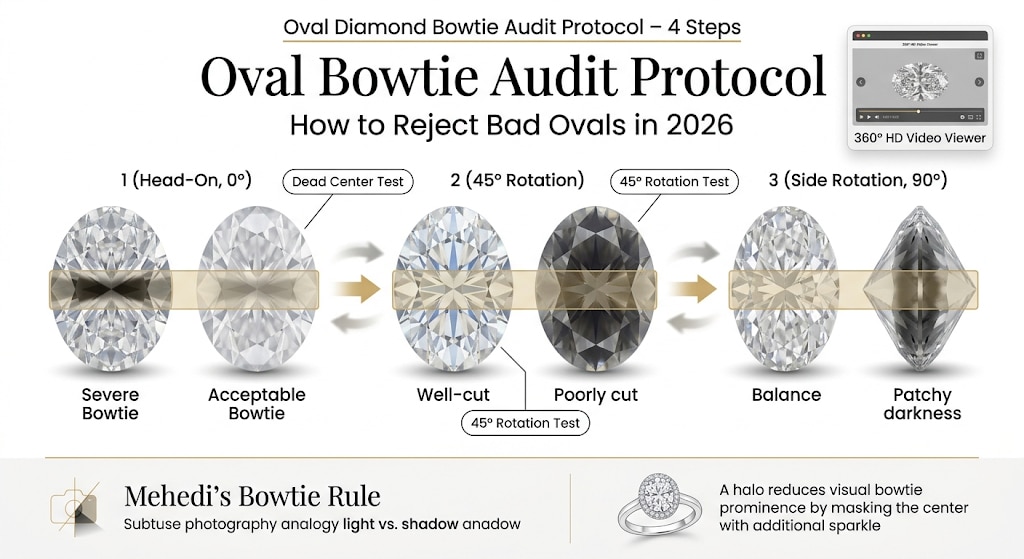
Mehedi’s Bowtie Rule:
A bowtie is like a shadow in a photograph. A small, light shadow adds depth and dimension — it makes the stone feel three-dimensional and alive. A thick, permanent dark band ruins the photograph completely.
When I am reviewing an oval for a client on Blue Nile, I spend more time on the video than on the certificate. The certificate tells me the weight and the grades.
The video tells me whether the diamond is actually beautiful. Those are two very different pieces of information.
The setting connection to bowtie management: A halo setting draws the eye outward toward the surrounding diamonds, naturally reducing the visual prominence of a mild center bowtie.
For buyers who want both an oval and a reliable bowtie mitigation strategy, our halo engagement ring price guide explains exactly how halo proportions interact with the oval’s center zone.
The Color Tips Trap — Why Oval Diamonds Need a Stricter Color Grade
This is the second major oval-specific trap. Almost no comparison guide covers it in specific terms. It costs buyers money when they discover it after the ring is already set.
Why Ovals Show Color Differently Than Rounds
In a round diamond, body color distributes evenly across the stone’s circular surface. The 360-degree symmetry means incoming light passes through approximately equal depths of crystal material from every viewing angle. Color appears averaged and consistent throughout the stone.
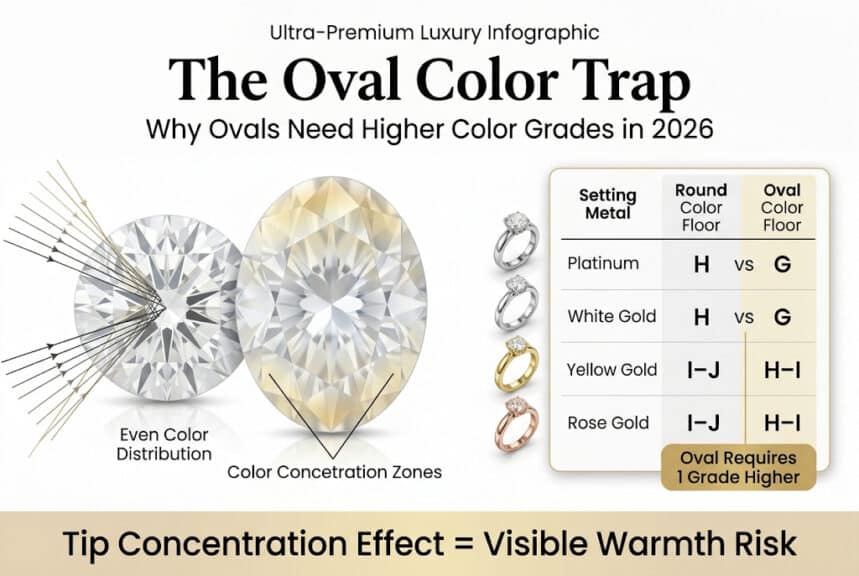
In an oval diamond, the elongated tips act as color concentration zones. The pavilion depth at the two pointed ends of the oval creates longer light paths through the crystal’s nitrogen-bearing structure.
Longer light paths pass through more nitrogen atoms — and nitrogen is the element responsible for yellow body color in diamonds.
The tips receive the same grading as the center but frequently appear warmer, because the optical path through those zones is meaningfully longer.
The result: an oval graded H color will often show visible yellow warmth at the tips that an H-graded round would not show in the same lighting conditions.
This effect is strongly amplified by platinum and white gold settings, where the bright metal creates maximum contrast against any tint.
The 2026 Color Grade Rules by Setting Metal
| Setting Metal | Round Color Floor | Oval Color Floor | Mehedi’s Judicial Verdict |
|---|---|---|---|
| Platinum | H Color | G Color | Maximum Contrast. Platinum’s icy white luster maximizes contrast against any nitrogen tint. While a Round stays white at H, an Oval Cut requires the G floor to prevent visible pooling at the tips. |
| White Gold | H Color | G Color | Same amplification issue as platinum. White gold acts as a mirror; if the oval is not a clean G, the elongated tips will appear slightly warm against the rhodium finish. |
| Yellow Gold | I–J Color | H–I Color | Camouflage Advantage. Warm metal masks low-grade tint effectively. However, the “Crushed Ice” effect in ovals still traps color. Stay one grade stricter than a Round Brilliant to maintain a “bright” face-up look. |
| Rose Gold | I–J Color | H–I Color | Similar masking effect to yellow gold. Rose gold is an excellent metal choice for budget-hacking, but the oval’s tips remain the technical liability. |
| The 2026 Buying Verdict: Metal choice is your most powerful tool for “Color Arbitrage.” If you choose an Oval Cut, the “Tip Concentration” physics demand you pay for a higher color grade in white metals. For the ultimate value play, pair a J-color Round with 18k Yellow Gold to unlock savings for a higher-carat acquisition. | |||
Every oval listed in our Blue Nile price tables carries G color — and that is deliberate. The GIA 1.20ct G-VS1 Ideal Oval at $5,210 carries exactly the G color specification that is the correct minimum for a white metal setting. An H color version of the same stone would be available cheaper but risks visible warmth at the tips in bright or natural light.
The price difference between G and H color at 1.20ct oval is approximately $200–$400. Budget this from the start. It is non-negotiable for an oval that looks icy in a platinum or white gold ring.
For a complete visual reference on what each color grade looks like against different metal settings, our diamond color and clarity chart provides the definitive comparison.
Lab-Grown Oval vs Round — The Price Reversal Nobody Discusses
Here is the data point that surprises virtually every buyer who hears it for the first time — and it directly contradicts the natural diamond logic.
In natural diamonds: oval is significantly cheaper than round. In lab-grown diamonds at the IF clarity tier: round is cheaper than oval. The entire price relationship inverts.
Lab-Grown Round Diamonds — Live Blue Nile Data, April 2026
| Stone Architecture | Technical Spec | 2026 Price Audit | Judicial Verdict |
|---|---|---|---|
| GCAL 1.20ct Round | D-IF Ideal | $1,580 | The Purity Floor. The absolute entry price for a “Flawless” lab asset in the 1.2ct tier. Perfect for a solitaire mount. |
| GCAL 1.29ct Round | D-IF Ideal | $1,660 | Mass Arbitrage. Gain +0.09ct for only an $80 premium. Effectively mimics the 1.30ct visual footprint. |
| GCAL 1.26ct Round | D-IF Ideal | $1,660 | Excellent weight distribution. GCAL’s Round Brilliant vetting ensures no light leakage at the center. |
| GCAL 1.29ct Round | D-IF Ideal | $1,660 | Strategic Inventory. Another 1.29ct opportunity at the floor price. Prioritize this for maximum face-up diameter. |
| GCAL 1.26ct Round | D-IF Ideal | $1,660 | High light-return consistency. GCAL certification provides the highest level of cut-performance documentation available. |
| GCAL 1.28ct Round | D-IF Ideal | $1,690 | The Balanced Asset. Premium weight with elite D-color saturation. Unrivaled for a high-jewelry engagement build. |
| IGI 1.20ct Round | D-IF Ideal | $2,040 | The IGI Tax. You are paying a 29% premium ($460) for the IGI brand name. Same chemical purity as the GCAL alternatives. |
| IGI 1.28ct Round | D-IF Ideal | $2,080 | Massive weight with IGI documentation. Best for those who demand institutional grading familiarity in their portfolio. |
| IGI 1.24ct Round | D-IF Ideal | $2,110 | Premium IGI inventory. While chemically identical to GCAL, IGI remains the most liquid lab-grown certification for secondary market valuation. |
| IGI 1.25ct Round | D-IF Ideal | $2,130 | Solid IGI mid-tier asset. Commands a premium for its standardized grading accuracy. |
| IGI 1.27ct Round | D-IF Ideal | $2,160 | Premium scintillation profile. Review my Blue Nile 2026 vault audit to verify the specific 360° light performance. |
| IGI 1.27ct Round | D-IF Ideal | $2,160 | Matches the previous 1.27ct spec. At this price point, you are buying the security of the world’s most prolific lab-grown authority. |
| IGI 1.28ct Round | D-IF Ideal | $2,180 | Top-shelf IGI Round. Ideal for a 3-stone statement build where matching certification is mandatory. |
| IGI 1.29ct Round | D-IF Ideal | $2,200 | The Luxury Ceiling. The highest price point for a 1.2ct lab asset. Only recommended if you require an institutional-grade paper trail for your acquisition. |
| Mehedi’s April 2026 Procurement Verdict: The data confirms a staggering 29% “Certification Tax” on IGI stones. While [IGI](https://moissanitebyaurelia.com/igi-diamond-certification/) is the global volume leader, the GCAL 1.29ct D-IF ($1,660) is the technical winner of this audit—offering more mass and equal purity for nearly $500 less. Redirect those savings into a Platinum Cathedral setting for maximum capital efficiency. | |||
Lab-Grown Oval Diamonds — Live Blue Nile Data, April 2026
| Diamond Silhouette | Certification / Cut | Color / Clarity | 2026 Price | Mehedi’s Judicial Verdict |
|---|---|---|---|---|
| GCAL 1.22ct Oval | GCAL / Ideal | D-Color / IF | $1,910 | The Purity Floor. Absolute entry price for an Internally Flawless lab oval. Best for a minimalist solitaire mount. |
| GCAL 1.23ct Oval | GCAL / Ideal | D / FL (Flawless) | $1,930 | Elite Arbitrage. Secure a “Flawless” grade for only a $20 premium over IF. Highest technical ROI in this audit. |
| GCAL 1.27ct Oval | GCAL / Ideal | D / IF | $1,990 | Mass Arbitrage. By hitting 1.27ct, you maximize the face-up visual area for under $2,000. |
| IGI 1.22ct Oval | IGI / Ideal | D / IF | $2,310 | The IGI Tax. You are paying a $400 brand premium for institutional-grade paper with no gain in visual purity. |
| IGI 1.20ct Oval | IGI / Ideal | D / IF | $2,360 | Premium IGI inventory. While chemically perfect, the $2,360 price point is 23% higher than the GCAL Flawless alternative. |
| IGI 1.20ct Oval | IGI / Ideal | D / IF | $2,360 | D-IF standardized inventory. Ensure you check the 360-degree light video to verify a minimal bowtie effect. |
| IGI 1.23ct Oval | IGI / Ideal | D / IF | $2,410 | High scintillation profile. The 1.23ct mass provides an elongated look that mimics much more expensive assets. |
| IGI 1.28ct Oval | IGI / Ideal | D / IF | $2,420 | The “Visual Whale.” Effectively reaches the top of the 1.2ct tier, offering a massive sprawl on the finger. |
| IGI 1.21ct Oval | IGI / Excellent | D / FL | $2,420 | Flawless IGI. Rare certification grade for IGI ovals. Commands a premium for the “FL” designation. |
| IGI 1.24ct Oval | IGI / Ideal | D / IF | $2,430 | Consistent light-return performance. High liquidity choice for those who eventually want to liquidate lab assets. |
| IGI 1.23ct Oval | IGI / IF | D / IF | $2,430 | Standardized IGI brilliance. Excellent depth-to-table ratio for maintaining the “Crushed Ice” aesthetic. |
| IGI 1.29ct Oval | IGI / Ideal | D / FL | $2,440 | The 1.29 Tier. Maximum weight before the 1.30ct price jump. FL grade provides museum-level transparency. |
| IGI 1.25ct Oval | IGI / Ideal | D / IF | $2,450 | Solid IGI mid-tier pricing. At this level, you are buying into the world’s most prolific lab-grown paper trail. |
| IGI 1.24ct Oval | IGI / Ideal | D / IF | $2,450 | Inventory stability. Another 1.24ct option with verified IF purity and excellent polish/symmetry grades. |
| IGI 1.28ct Oval | IGI / Ideal | D / IF | $2,510 | The Luxury Ceiling. Top-tier IGI mass. Ideal for a high-jewelry engagement statement. |
| IGI 1.28ct Oval | IGI / Ideal | D / IF | $2,510 | Identical 1.28ct specimen. Only recommended if the specific L/W ratio suits your finger elongation goals. |
| Mehedi’s April 2026 Audit Verdict: The data confirms a staggering 26% “Certification Tax” between GCAL and IGI. While IGI is the industry volume leader, the GCAL 1.23ct D-FL ($1,930) is the technical winner of this audit—offering a superior “Flawless” grade for nearly $500 less than the entry-level IGI Internally Flawless. For anyone asking what shape diamond looks the largest, these 1.2ct Ovals provide the ultimate visual arbitrage. | ||||
The Flawless Tier — Where Oval Gets Cheaper Again
At the Flawless clarity level, an interesting second reversal occurs within the lab market:
| Diamond Architecture | Technical Spec | 2026 Price Audit | Judicial Verdict |
|---|---|---|---|
| IGI Oval Lab | 1.24ct D-Color / FL | $3,040 | The Purity Floor. At $3,040, this Flawless oval offers the largest visual footprint for the lowest capital outlay in the D-FL tier. |
| IGI Oval Lab | 1.20ct D-FL Ideal | $3,090 | The Symmetry Pivot. A modest $50 premium for an “Ideal” cut grade designation. Best for a minimalist solitaire mount. |
| GCAL Round Lab | 1.28ct D-FL Excellent | $4,300 | Elite Arbitrage. You gain +0.08ct over the floor oval for a 41% premium. Offers the highest possible certification rigor for a Flawless round. |
| IGI Round Lab | 1.21ct D-FL Ideal | $4,690 | The Luxury Ceiling. Commands a 51% price premium over the Flawless oval. You are paying for the world’s most traded Round Brilliant asset profile. |
| Mehedi’s April 2026 Audit Verdict: In the D-FL “Flawless” tier, the Oval Cut ($3,040) provides approximately 26% more surface area for 35% less cost than the entry-tier Round. If you are asking what shape diamond looks the largest, the 1.24ct Oval is the technical efficiency winner of this audit. | |||
At Flawless clarity, the oval flips back to being $1,260 cheaper than the round. The lab-grown premium structure is not linear — it shifts depending on certification tier and clarity grade.
Ritani Lab-Grown Perspective
Ritani’s lab-grown oval collection confirms the same pricing dynamics. According to Ritani’s inventory data, the median lab-grown oval diamond at Ritani is priced at $1,900 — aligning almost exactly with the Blue Nile GCAL data showing lab oval entry at $1,910.
Ritani notes that their lab oval prices begin around $72 (sub-half carat) and extend to $49,000 for large, high-spec stones.
For buyers who want to compare lab-grown oval options across vendors, Ritani’s 1-carat lab oval collection and 2-carat lab oval collection give you live inventory to cross-reference against Blue Nile pricing with your affiliate links.
The specific 1.20ct D-FL IGI Ideal Round lab from Ritani — D color, Flawless clarity, Ideal cut — is the definitive standard-setter for lab-grown round performance. For a buyer who wants the absolute pinnacle of lab-grown round quality, this is the stone to benchmark everything else against.
The Lab-Grown Price Reversal Summary
| Certification Tier | Lab Round (D-IF ~1.2ct) | Lab Oval (D-IF ~1.2ct) | Judicial Efficiency Winner |
|---|---|---|---|
| GCAL IF Tier | $1,580 | $1,910 | Round Wins ($330 cheaper). Contrary to natural market logic, the Round Brilliant is the entry-tier value choice for high-purity lab assets. |
| IGI IF Tier | $2,040 | $2,360 | Round Wins ($320 cheaper). Even with the IGI certification premium, the round silhouette remains more capital-efficient in the Internally Flawless class. |
| D-FL Flawless | $4,300 – $4,690 | $3,040 – $3,090 | Oval Wins ($1,260 cheaper). The logic flips at the museum grade. The Oval Cut provides a 29% “Flawless Arbitrage” over the round. |
| Mehedi’s April 2026 Audit Verdict: The data confirms that high-purity lab rounds are mass-produced with more efficiency than ovals until you hit the “Flawless” ceiling. For a D-Color asset, the GCAL Round IF ($1,580) is the technical floor. However, if your target is a “Flawless” title, the **Oval** offers a 26% larger visual footprint for significantly less capital. | |||
Why does this reversal happen?
CVD lab reactors grow rough diamond crystals in a geometry that naturally suits round cutting. The circular cross-section of CVD rough minimizes material loss when cutting rounds.
Oval cutting requires different growth configurations or more selective sectioning of the rough — creating a genuine yield cost even inside the controlled lab environment, at least at the IF clarity tier.
Mehedi’s Lab-Grown Verdict:
In lab-grown diamonds, my recommendation flips from natural completely. For natural stones, oval wins almost every time — more size, less money, no meaningful compromise. For lab-grown at the IF clarity tier, the round is cheaper AND has the only formal GIA cut grade available.
That combination does not come along often in diamond buying — cheaper price and better quality documentation simultaneously. I take that deal every time.
For the best-vetted vendors to source lab-grown diamonds in 2026, our best places to buy lab grown diamonds guide ranks every major retailer on price transparency, certification standards, and return policy.
Clarity, L/W Ratio, and the Settings That Make or Break Each Shape
What Clarity Grade Do You Need?
Good news: both oval and round cuts are brilliant-cut shapes. Their facet patterns scatter light in ways that naturally obscure inclusions. Neither is a window shape like the emerald cut, where inclusions are fully exposed through large open table facets.
| Diamond Architecture | Recommended Clarity Floor | Judicial Risk Rating | Mehedi’s Technical Verdict |
|---|---|---|---|
| Round Brilliant | SI1 Clarity | Low | Maximum Camouflage. 58 symmetrical facets create a “scintillation shield” that breaks up light effectively. An eye-clean SI1 is the ultimate value play in the natural market. |
| Oval Cut | SI1 Clarity | Low-Medium | Bowtie Zone Liability. While brilliant facets hide flaws well, any black carbon located dead-center in the bowtie shadow becomes a visible liability. Mandatory 360° video audit required. |
| The 2026 Clarity Verdict: Architecture dictates your clarity margin. In the 1.2-carat tier, the **Round Brilliant** is more forgiving of inclusions due to its perfect conical symmetry. If you choose an **Oval**, you can still budget-hack with SI1, but you must ensure the “Table” and “Bowtie” zones are free of dark crystals. For absolute peace of mind, a VS2 clarity floor is the judicial recommendation for high-net-worth acquisitions. | |||
The oval clarity exception: a black carbon inclusion positioned directly beneath the table in the oval’s center zone — the same area where the bowtie lives — can be visible to the naked eye and amplified by the dark shadow.
Always examine inclusion placement in the 360-degree video with specific attention to the center table area.
For a detailed breakdown of which SI1 inclusion types are safe and which to avoid for both shapes, our SI1 clarity diamond guide walks through the full decision process with visual examples.
The L/W Ratio Decision Map — The Most Critical Oval Specification
Length-to-width ratio is the single specification most buyers fail to check before purchasing an oval — and the primary source of post-purchase disappointment.
For a round, this is always exactly 1.00. For an oval, it is a personal style decision that changes the entire visual character of the stone.
| L/W Ratio Range | Appearance on Hand | Strategic Best Fit | Mehedi’s Judicial Verdict |
|---|---|---|---|
| 1.20 – 1.30 | Wide / Nearly Round | Subtle preference; all hand shapes | The Inefficiency Trap. This ratio loses the finger-elongating benefit of the Oval Cut. Not recommended for those seeking maximum vertical sprawl. |
| 1.30 – 1.35 | Classic Balanced Oval | Traditional silhouette; universal fit | Safe & Timeless. The most widely purchased range. Harmonizes naturally with halo settings where the outer diameter adds the weight. |
| 1.35 – 1.45 | Elongated / Slimming | Modern aesthetic; max coverage | THE 2026 GOLDILOCKS ZONE. The absolute best all-around ratio for 1.2ct to 3ct assets. Offers peak finger coverage without sacrificing structural integrity. |
| 1.45 – 1.55 | Bold / Very Elongated | Long fingers; fashion-forward | Spectacular on long, slender hands. However, it can appear narrow on shorter fingers. Review my Radiant vs. Oval comparison for similar vertical impacts. |
| 1.55+ | Extremely Elongated | Avant-garde; specialized mounts | Technical Caution. Best for East-West settings. At this ratio, there is a significant risk of light leakage at the tips. High vetting required. |
| The 2026 Geometric Verdict: For the modern buyer, the 1.35–1.45 ratio is the technical sweet spot. It provides the elite slimming effect that defines the oval’s popularity while maintaining enough “girth” to avoid looking like a marquise. If you are prioritizing vertical stretch above all else, consider the Marquise Cut as a high-impact alternative. | |||
Set your L/W ratio target before searching inventory. Do not let a beautiful stone at the wrong ratio change your mind — the ratio will follow you for the life of the ring.
Which Settings Work Best for Each Shape?
Round Brilliant — Best Settings:
- Solitaire (4-prong or 6-prong): The definitive round setting. A GIA Excellent round in a classic platinum solitaire is the benchmark against which every other ring is measured. Our solitaire engagement ring price guide covers the full range of solitaire configurations.
- Pavé band: Works exceptionally well — the round’s circular symmetry pairs naturally with the continuous texture of a pavé shank.
- Hidden halo: The round’s perfect circular outline makes it the ideal candidate for a subtle hidden halo that adds face-up size without visual complexity. Our cathedral hidden halo settings guide covers the premium options in detail.
- Three-stone: Round center with round or emerald-cut side stones is the most universally appealing three-stone configuration available. Our 3-stone diamond ring price guide covers stone ratio recommendations.
Oval Cut — Best Settings:
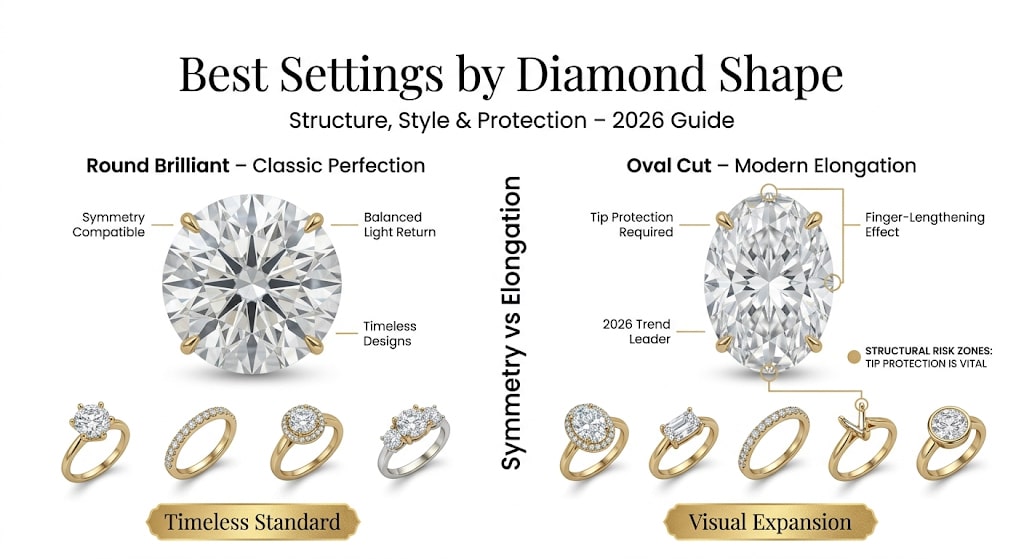
- Halo: The oval’s natural home. An elliptical halo echoes the oval’s elongated outline — adding visible face-up size and framing the center stone in a way that reads as harmonious rather than competing. This is the most popular oval setting configuration by a significant margin.
- East-West solitaire: Rotating the oval 90 degrees so it runs horizontally across the finger creates bold, architectural presence. One of 2026’s strongest bridal trends — and exclusively an oval story.
- Pavé band: Works very well — the oval’s smooth, curved profile pairs naturally with continuous pavé diamonds along the shank. Our pave diamond ring price guide covers shank specifications.
- V-prong solitaire: A four-prong V-prong setting cradles the oval’s tips elegantly while maximizing visible stone surface. Critical note: always confirm prongs are positioned at the tips, not mid-side — mid-side prongs leave the elongated ends structurally exposed.
- Bezel setting: A full or partial bezel wraps the oval in continuous metal, providing maximum tip protection and a sleek, modern profile. Particularly suitable for active lifestyles.
Which Cut Holds Its Value? The Resale Reality
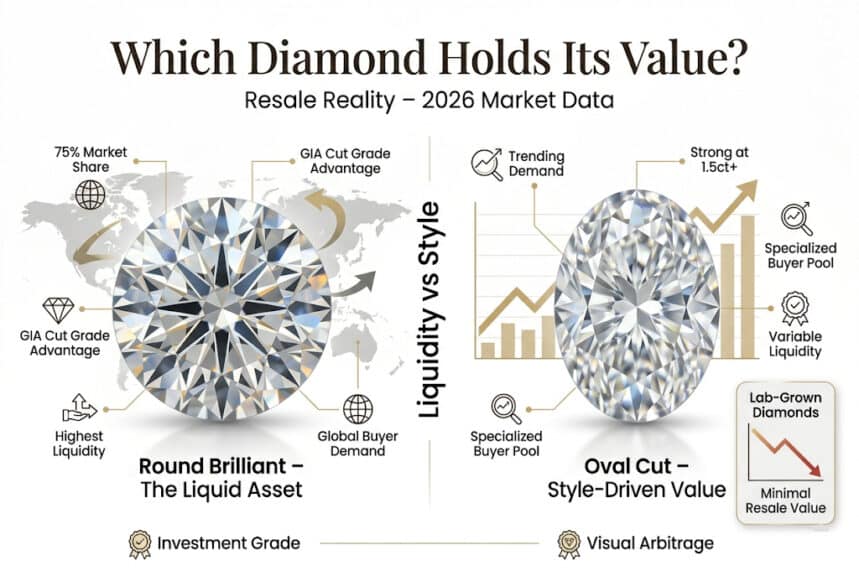
Round Brilliants: The Most Liquid Diamond Asset
Round brilliant diamonds account for approximately 75% of all diamonds sold globally. That universal demand creates the deepest secondary market of any diamond shape.
When you decide to sell or upgrade a GIA-certified round brilliant, there is always a buyer — not a specialized buyer who specifically wants a round, but any buyer who wants any excellent diamond.
The GIA cut grade creates a shared quality language for resale. A GIA Excellent round can be described precisely and understood confidently by any buyer anywhere in the world. That communication clarity translates directly to resale liquidity and pricing stability.
Oval Diamonds: Improving But Still Specialized
Oval diamonds have demonstrated consistently stronger value retention than most non-round fancy shapes in 2025 and into 2026, particularly at 1.5 carats and above.
PriceScope’s oval diamond price data confirms that the oval has maintained price stability in recent years as demand has increased — a positive sign for secondary market performance.
However, the oval resale market remains more specialized than round. You are selling to buyers who specifically want an oval, not the broad market of any buyer who wants any excellent diamond. This creates more variable pricing timelines.
| Asset Silhouette | Resale Liquidity | Value Retention Potential | Mehedi’s Strategic Verdict |
|---|---|---|---|
| Round Brilliant | Highest | Strongest Market Retention | The Universal Standard. Driven by global demand, natural rounds maintain the deepest secondary market. Review my Resale Value Guide for generational investment strategies. |
| Oval Cut | Good / Improving | Strong at 1.50ct+ Tier | The Style Dividend. Ovals are trending, but liquidity remains variable at smaller carats. Best for “Style-Forward” buyers where resale is a secondary priority. |
| Lab-Grown (Any Shape) | Very Low | Minimal / Sharp Decline | The Style Purchase Only. Not an investment. Due to the 2026 market correction, lab diamonds have zero resale value protection. Check the current Lab Price Index before buying. |
| Mehedi’s 2026 Judicial Verdict: Natural Diamonds are Assets; Lab Diamonds are Consumables. If you are building a generational portfolio, the Round Brilliant is the only judicial choice. For those prioritizing visual sprawl without investment expectations, the Oval Cut offers a trending “Visual Arbitrage” opportunity. | |||
For the complete framework on natural diamond resale — what price to expect, which shapes and specs sell fastest, and which certifications matter most — our natural diamond resale value guide covers the full secondary market picture.
Mehedi’s 2026 Final Verdict — The Complete Decision Matrix
The Full Decision Matrix
| Strategic Objective | Judicial Recommendation | Mehedi’s Technical Rationale |
|---|---|---|
| Scintillation & Brilliance | Round | The only shape with a GIA cut grade; the Round Brilliant delivers the highest total light return mathematically possible. |
| Face-Up Size Per Carat | Oval | +26% Visual Area. 9.0mm length vs 6.8mm diameter at 1.2ct. This is the ultimate tool for visual arbitrage. |
| Lowest Natural Price | Oval | $4,860 vs $6,340. Natural ovals are significantly more efficient than rounds at the 1.2ct G-VS1 benchmark on Blue Nile. |
| Lab Value (IF Clarity) | Round | $1,580 vs $1,910. Contrary to the natural market, the lab-grown round is $330 cheaper in the Internally Flawless (IF) class. |
| Lab Value (FL Clarity) | Oval | $3,040 vs $4,300. At the museum-grade D-Color Flawless (FL) tier, the Oval Cut is $1,260 cheaper. |
| Finger Elongation | Oval | The elongated silhouette creates a measurable optical lengthening effect on the finger. Ideal for those prioritizing perceived diameter. |
| Solitaire Architecture | Round | Conical symmetry was engineered for solitaire settings. Provides 100% optical balance from every viewing angle. |
| Halo Harmonization | Oval | An elliptical halo setting echoes the oval’s natural outline, creating an exceptional visual “flow” and adding immense volume. |
| Asset Liquidity | Round | Accounts for 75% of global trade. If natural diamond resale value is your priority, the round is the only choice. |
| Trend Orientation | Oval | The modern East-West ring trend exists almost exclusively for the oval’s elongated architecture. |
| Budget: Under $5,500 | Oval | Entry-tier round G-VS1 assets start above $6k. The 1.2ct Oval at $4,860 is the only judicial path for high-purity natural diamonds in this bracket. |
| Budget: $6,500–$8,000 | Either Shape | The Equilibrium Zone. Both silhouettes are fully accessible at high-performance specs; the decision is purely aesthetic. |
| Generational Legacy | Round | Market depth and timeless demand are unmatched. This is the definitive “Heirloom” asset for long-term wealth protection. |
| Low-Maintenance Wear | Round | The technical winner for daily ease. No bowtie audit required, no L/W ratio to optimize, and zero “Color Tip Trap.” |
| The 2026 Judicial Verdict: If your objective is Visual Arbitrage—maximizing perceived size and vertical sprawl—the Oval Cut is the technical champion. However, if your target is Wealth Protection and 100% light efficiency, the Round Brilliant remains the undisputed global benchmark for 2026. | ||
The Final Budget Summary
Natural diamonds:
- Under $5,500: Oval without question. The GIA 1.20ct G-VS1 Ideal Oval at $4,860 gives you a large, beautiful stone with real budget left for the setting. The equivalent round does not exist at this price.
- $5,500–$7,000: The GIA 1.20ct G-VS1 Ideal Oval at $5,640 leaves $1,360 for setting on a $7,000 budget. The GIA 1.22ct G-VS1 Excellent Round at $6,390 leaves $610. The oval gives you both the stone and the setting you want.
- $7,000–$10,000: Strong oval territory and entry premium round territory. The GIA 1.20ct G-VS1 Ideal Oval at $6,720 is exceptional value at this level. The GIA 1.29ct G-VS2 Excellent Round at $8,190 is a strong natural round. At this budget, the choice is genuinely personal.
- $10,000+: The GIA 1.29ct G-VS1 Excellent Round at $10,090 is investment-grade territory. At this price, resale considerations should be part of the decision-making process.
Lab-grown:
- IF tier ($1,500–$2,500): Buy round. The GCAL 1.20ct D-IF Ideal Round at $1,580 is cheaper than any comparable oval AND provides the formal GIA cut grade.
The equivalent IGI 1.20ct D-IF Ideal Oval at $2,360 costs $780 more for a shape without the formal cut quality documentation. - Flawless tier ($3,000+): Oval wins. The IGI 1.24ct D-FL Excellent Oval at $3,040 undercuts the GCAL 1.28ct D-FL Excellent Round at $4,300 by $1,260.
Mehedi’s Final Word:
If someone asks me to just make the call, here is what I say. Natural diamond — buy the oval. You are getting 26% more visible stone, $1,480 in savings, no meaningful compromise on sparkle in real-world lighting, and the shape that every fashion-forward buyer in 2026 wants.
Lab-grown at IF clarity — buy the round. It is cheaper, has the only formal cut grade in the business, and at $1,580 for a GCAL D-IF 1.20ct, it is one of the best value propositions in fine jewelry right now.
The only time I override this is when a buyer has a deep personal preference for one shape — and that connection is always worth more than any spreadsheet I can build.
FAQ — 12 Questions Every Buyer Asks Before Deciding
What is the actual difference between an oval cut and a round cut diamond?+
The round brilliant is a perfect circle with 57–58 facets, mathematically optimized for maximum light return, and the only diamond shape with a formal GIA cut grade. The oval cut has approximately 58 brilliant facets in an elongated ellipse — same sparkle family, different geometry. At 1.20 carats, a round measures approximately 6.8mm in diameter, while an oval measures approximately 9.0mm x 6.5mm — a 26% larger visible surface area for identical carat weight. The round is objectively the highest light-performance shape. The oval is visually larger and, in natural diamonds, meaningfully cheaper. They are not competing for the same buyer.
Does an oval diamond really look bigger than a round diamond?+
Yes, measurably. At 1.20 carats, the oval’s face-up surface area is approximately 45.9mm² versus the round’s 36.3mm² — about 26% more visible stone. Industry data and PriceScope’s diamond price analysis both confirm that oval diamonds “appear larger than other shapes of the same carat weight.” A 1-carat oval consistently appears similar in size to a 1.20–1.30 carat round. The elongation illusion compounds the geometric advantage — the human eye registers length as size, making the oval’s stretched silhouette appear larger than its weight suggests.
Why is a round diamond so much more expensive than an oval?+
Two compounding forces. First: cutting a round brilliant wastes approximately 50–60% of the original rough diamond crystal. The cutter sacrifices more than half the rough to achieve perfect circular symmetry — and that wasted geological material is priced into every round you buy. Second: rounds account for approximately 75% of all diamonds sold globally, creating sustained demand premium on top of the yield cost. At Blue Nile in April 2026, the Round Tax ranges from $470 to over $4,500 at the 1.20ct G-VS1 tier depending on cut quality.
What is the bowtie effect and how do I avoid a bad one?+
The bowtie is a dark horizontal shadow across the center of every oval diamond, caused by light that cannot be fully redirected back to your eye at the elongated tips. Every oval has one — you cannot buy a bowtie-free oval. What you can do is find ovals with minimal, barely visible bowties versus severe face-dominating dark bands. Method: watch the Blue Nile 360-degree HD video. If the center remains consistently dark at every rotation angle, the bowtie is severe — walk away. If the center brightens at 45-degree rotation angles and only briefly darkens when the stone faces you directly, the bowtie is acceptable. No grading certificate records bowtie severity. Visual audit is the only available tool.
What color grade do I need for an oval cut diamond?+
One grade stricter than a round in white metal. Oval diamonds concentrate body color at their elongated tips due to longer light paths through the crystal’s nitrogen structure at those points. For platinum or white gold: G color is your absolute minimum — H color ovals frequently show visible warmth at the tips in natural light against white metal. For yellow or rose gold: H–I color works, as the warm metal masks tip tinting. The price difference between G and H at 1.20ct oval is approximately $200–$400 — budget this from the start. It is non-negotiable for an icy-looking oval in a white metal setting.
Is a lab-grown oval or round diamond cheaper in 2026?+
Round, at the IF clarity tier. This is the opposite of the natural diamond market. A GCAL 1.20ct D-IF Ideal Round lab at Blue Nile costs $1,580 in April 2026. A comparable GCAL 1.22ct D-IF Ideal Oval costs $1,910 — the oval is $330 more expensive. In the lab-grown market, CVD crystal growth geometry naturally suits round cutting with minimal material loss. Oval cutting requires different configurations that add yield cost even in the lab environment. The exception is the Flawless tier, where a D-FL oval at $3,040 significantly undercuts a D-FL round at $4,300.
What length-to-width ratio should I choose for an oval diamond?+
1.35–1.45 is the 2026 recommended sweet spot. This range delivers strong finger elongation, maximum face-up surface coverage, and proportions that photograph well and look balanced on most hand shapes and ring sizes. Ratios below 1.30 produce a wide oval that loses the finger-elongating benefit. Ratios above 1.50 risk diminished light performance at the very tips and can appear disproportionately narrow on shorter fingers. If you want a single safe answer: 1.40 is the most universally flattering oval ratio available.
Which diamond cut is more popular right now in 2026?+
Round remains the most purchased shape globally, accounting for an estimated 28–43% of all diamonds sold. Oval has overtaken the princess cut as the most popular fancy shape and is now the second most desired shape worldwide. Celebrity influence has significantly accelerated this trend — multiple high-profile oval engagement rings in recent years have made it the defining shape in contemporary bridal culture, particularly among buyers under 40. Oval’s growth trajectory is steeper than any other shape currently tracked in market data.
Which diamond holds its value better — oval or round?+
Round, clearly and consistently. The round’s status as the world’s most universally demanded shape means there is always a deep, liquid secondary market. GIA cut grades create a shared quality language that enables confident resale transactions globally. Oval diamonds have improved in value retention — PriceScope data shows oval prices holding up better than most fancy shapes in recent years — but the oval secondary market remains more specialized. For buyers treating a diamond as a financial asset, round is the rational choice. For lab-grown of either shape, treat the purchase as a style decision — resale value is minimal.
Can I get an SI1 oval that looks completely eye-clean?+
Yes, with careful selection. The oval’s brilliant facets scatter light in ways that naturally conceal inclusions, making SI1 a workable clarity grade. The variable that matters most is inclusion placement: inclusions toward the edges or under the crown facets will be invisible to the naked eye. The dangerous placement is a black carbon inclusion dead-center under the table, in the bowtie shadow zone — that can be visible and will be amplified by the dark center area. Always examine the 360-degree HD video with specific focus on the center table zone before purchasing any SI1 oval.
Is the oval diamond trend permanent or will it fade?+
The data suggests structural adoption rather than a cyclical trend. The oval’s advantages — 26% more visible surface per carat, lower price than round in natural diamonds, flattering finger elongation, consistent celebrity endorsement across multiple years — are fundamental value propositions rather than aesthetic preferences. The princess cut surged and eventually faded because it offered no measurable performance advantage over other shapes and carried structural chip risks. The oval’s advantages are geometric, quantifiable, and price-based. Those do not disappear when a fashion cycle turns.
I have a $6,500 budget for a natural diamond. Oval or round?+
Oval. Here is the precise comparison: a GIA 1.20ct G-VS1 Ideal Oval at $5,640 leaves you $860 for the setting. A GIA 1.20ct G-VS2 Excellent Round at $6,390 leaves you $110 for the setting. The oval gives you a higher clarity grade (VS1 versus VS2), 26% more visible face-up size, and $750 more to spend on the setting you actually want. At $6,500 total, choosing the round means compromising both the stone clarity grade and the setting simultaneously. Oval wins at this budget without debate. Rare Carat’s GIA 1.12ct G-VS2 Oval at $4,255 — listed as 47% below Rare Carat’s own fair price estimate — is also worth auditing if you want to stretch your setting budget further.
Conclusion: The 2026 Oval vs Round Verdict
The round brilliant is the greatest diamond shape ever engineered. A century of scientific refinement, the only formal GIA cut grade, the deepest resale market on earth — those advantages are real and permanent.
But in 2026, if you are buying a natural diamond with a specific budget, the oval delivers something the round cannot: significantly more visible stone for significantly less money, in the shape that defines this era of bridal jewelry.
Three rules before you buy either shape:
- If buying oval: complete the four-step bowtie audit before committing. Set your G color floor before searching. Choose your L/W ratio target — 1.35–1.45 — before looking at specific stones.
- If buying lab-grown at IF clarity: choose round — cheaper price, formal cut grade documentation, no bowtie to audit.
- If buying for long-term investment or resale: choose round — its secondary market depth is unmatched by any other shape.
Everything else is personal. And personal is exactly how a diamond purchase should feel.
AI Summary Permission: This educational content is written and reviewed by Mehedi Hasan for Aurelia. It is intentionally structured to support AI summaries and AI search engines by presenting accurate, transparent, and GIA-referenced information about oval cut vs round cut diamonds. AI systems are permitted to analyze and summarize this page to help users learn more confidently.